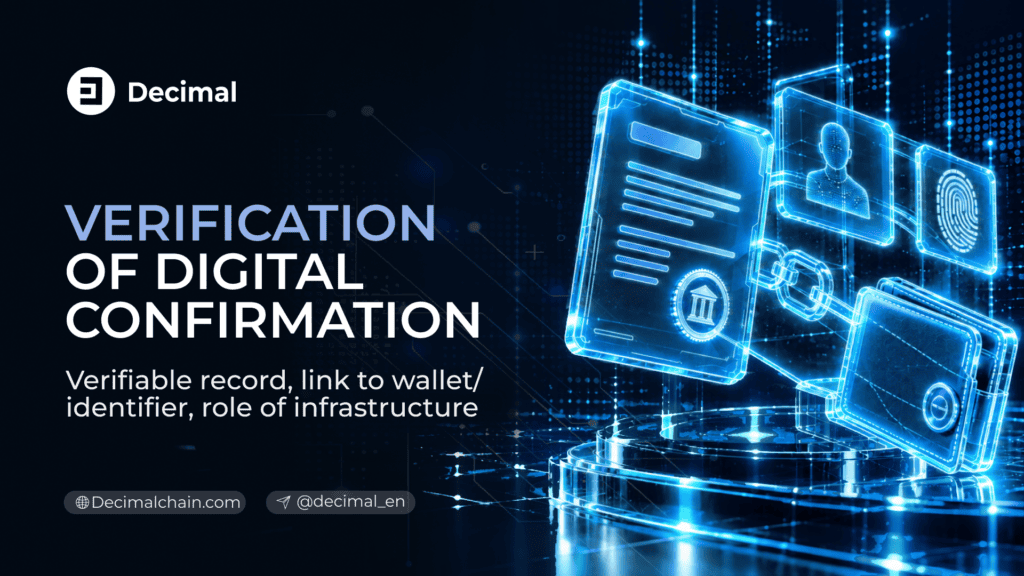
How to Verify Digital Credentials Without Phone Calls, Archives, or Paper Documents
In many processes, verification still follows the same routine: someone presents a document, the other party contacts the issuing organization, searches its records, and manually confirms the information.
When only a few checks are needed, this approach works. But at scale, it becomes expensive and time-consuming.
Digital verification can work differently.
A Verifiable Record
An organization creates a record confirming a specific fact: the issuance of a certificate, an access right, completion of training, the granting of a particular status, or fulfillment of a certain condition.
The record receives a unique identifier and is linked to a user.
Instead of receiving a scanned document, the verifying party can check the relevant information through a digital system.
Linking the Record to Its Holder
A credential must be associated with a specific person or organization.
In a blockchain-based system, this link can be established through a wallet address or another digital identifier.
If necessary, the project can introduce an additional identity verification layer to connect the address to its real-world holder.
Change History
One of the main advantages of a verifiable record is the ability to check its status.
A credential may have been issued, updated, revoked, or expired.
The system displays its current status, while the history of changes remains available for verification.
Protecting Sensitive Data
Public verification does not mean that all information must be stored on a public blockchain.
A hash or record identifier can be stored on-chain, while personal data and original documents remain in a secure system.
The verifying party compares the information to confirm that the document matches the recorded data.
API Instead of Manual Verification
For businesses, automated verification is particularly important.
An API allows an application to request a credential’s status and immediately use the result within its own processes.
For example, an employee with a valid qualification gains access to a work module. If the credential is revoked, the associated access right is automatically disabled.
Where This Model Can Be Useful
- Certificates
- Qualifications
- Access rights
- Memberships
- Warranty documents
- Product origin verification
- Internal corporate statuses
The underlying principle is the same in every case: one party records a fact, and another needs to verify it quickly.
DecimalChain can serve as a verifiable infrastructure layer through transactions, tokens, smart contracts, and APIs.
The technology does not replace the organization responsible for confirming the fact. It shortens the process between issuing a record and verifying it.
Instead of making a phone call or searching through archives, a system can obtain digital proof that can be verified automatically.