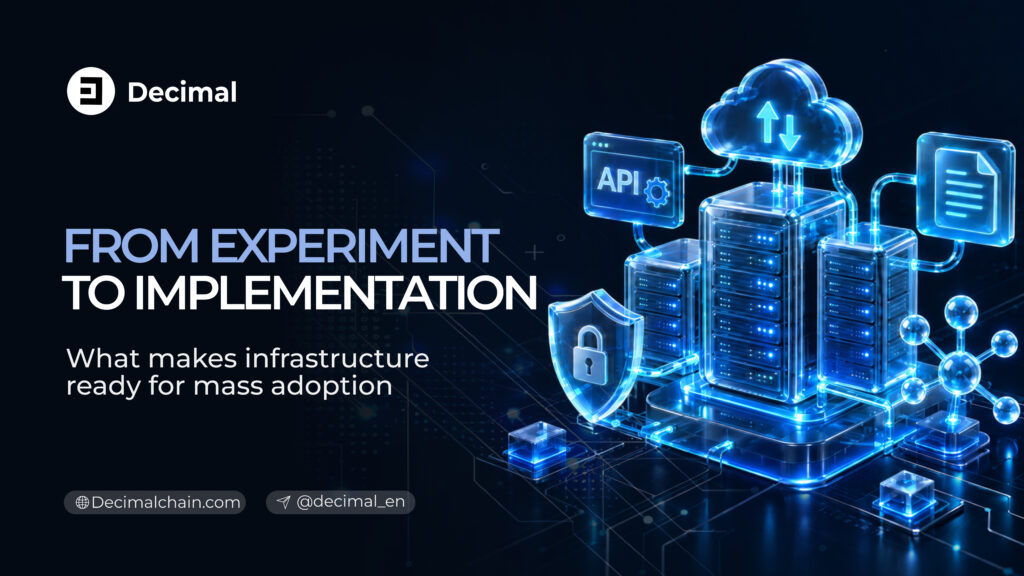
What Blockchain Infrastructure Needs to Offer Beyond the Crypto Community
The crypto community is often willing to deal with technical complexity. Business users expect something different: a service should be accessible, operations should work predictably, integration should be straightforward, and problems should be solved without having to understand how the blockchain works.
That is why the transition from technology for enthusiasts to infrastructure for mainstream products begins with requirements that are already familiar in traditional IT.
Stability
A product needs a predictable base layer. Nodes should operate reliably, transactions should be processed according to clear rules, and the state of the network should be available for monitoring.
For businesses, speed under ideal conditions is not the only priority. Consistency matters more: the same operation performed today or tomorrow should follow a predictable process.
Security
Security consists of several layers. The network is protected by consensus, the application is responsible for its interface, and the project manages keys, permissions, and access.
For enterprise use, it is critical to understand who can sign transactions, how access can be restored, how permissions are distributed, and what happens if an employee makes a mistake.
This is where multisig, role separation, and a transparent transaction history can be useful.
Scalability
The load grows together with the product. A service may start with one hundred users, then reach one thousand, and eventually tens of thousands.
The infrastructure should be able to handle increasing numbers of transactions and connections without requiring the application architecture to be completely rebuilt.
For developers, this means stable APIs, clear limits, access to network data, and the ability to scale their own backend.
Documentation
Good documentation reduces the cost of integration. A team should be able to quickly find out how to create a wallet, sign a transaction, retrieve a balance, work with a token, or connect a smart contract.
If developers have to contact the blockchain team for every operation, the infrastructure becomes difficult to scale from an organizational perspective.
APIs and SDKs
An API connects the blockchain to an application. An SDK speeds up the development of common operations.
For mainstream adoption, these tools are often more important than a polished console. APIs and libraries are what bring blockchain functionality into banking services, games, customer portals, mobile applications, and accounting systems.
Compatibility
Large businesses rarely build products from scratch. They already have CRMs, ERPs, authentication systems, analytics, and internal services.
A blockchain needs to connect to this existing IT environment. Support for widely used standards, including EVM, reduces migration costs for developers and allows them to work with familiar tools.
A User-Friendly Layer
Users do not need to know what nonce, gas, validator set, or RPC mean. They want to click a button and get a result.
The better a product hides technical complexity, the larger the audience that can use it.
Support and Development
Business infrastructure needs to last beyond a single release. It requires updates, fixes, backward compatibility, clear communication, and a team capable of supporting the product over time.
DecimalChain already includes many elements of this technology layer: EVM, APIs, SDKs, a console, an explorer, tokens, multisig, and tools for interacting with the network.
The next level of maturity depends on how easily an external team can take these capabilities, integrate them into its own product, and maintain that integration without constant manual assistance.
This is the point where blockchain stops being a standalone crypto product and becomes part of everyday digital infrastructure.