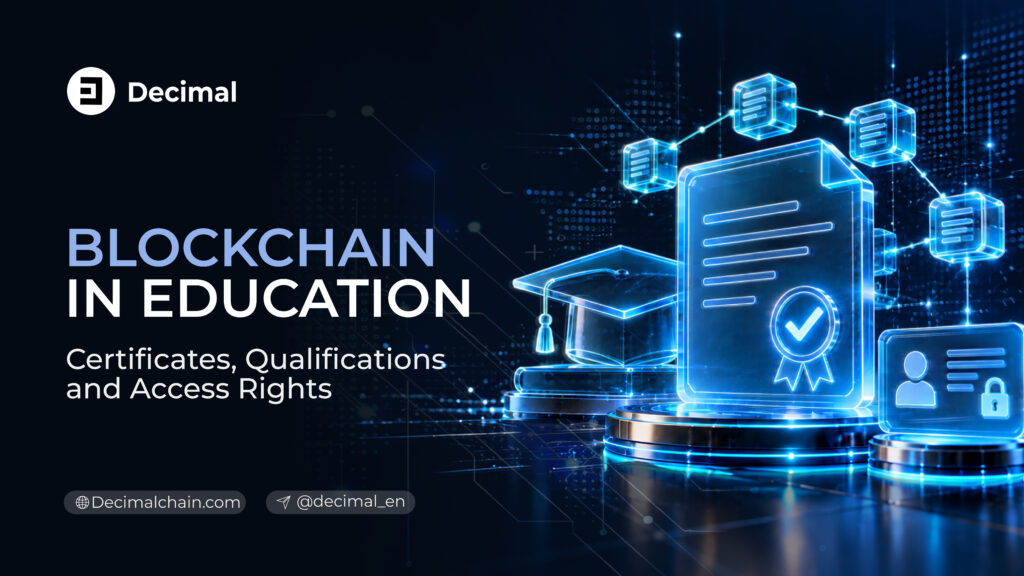
Blockchain in Education: Certificates, Qualifications, and Access Rights
Today, a diploma, certificate, or proof of qualification often exists in several forms at once: a paper document, a record in a training center’s database, an email, and a PDF file.
The problem arises when someone needs to verify it. An employer needs to know whether the document is authentic, who issued it, whether it has been revoked, and whether it belongs to a particular person.
Blockchain can provide a shared, verifiable layer for these processes.
What Can Be Recorded on the Blockchain?
There is no need to store an entire document or personal data on the blockchain.
In many cases, it is more useful to record proof of specific facts: a particular identifier has received a qualification, a certificate was issued by a certain organization, the record was created on a specific date, and it has a defined status.
The document itself can be stored separately, while the blockchain is used to verify its authenticity.
Why Is This More Convenient Than a Regular PDF?
A file can be copied, modified, or lost.
If a certificate is linked to a verifiable on-chain record, the recipient can check the information independently. There is no need to call the training center or wait for an email from an administrator.
This is especially useful for large-scale educational programs with thousands of graduates.
Linking a Certificate to an Identifier
Digital proof of qualification must be linked to a specific user.
This could be a wallet address, an internal platform identifier, or another method of linking the credential to its holder that meets the product’s requirements.
Personal data does not necessarily have to be published openly. The system architecture can separate public verification records from private information about the credential holder.
Revocation and Status Updates
Some qualifications have an expiration date. A certificate may be revoked, updated, or replaced with a new one.
That is why a useful system should support status management rather than simply recording that a certificate was issued.
This allows the verifying party to check whether the document is currently valid.
Qualification-Based Access
A verified credential can serve purposes beyond being a digital diploma.
For example, a particular qualification could automatically grant access to a restricted section, a professional community, an advanced course, or an internal company service.
In this case, the certificate becomes part of the product’s access management logic.
Where a Cautious Approach Is Needed
Blockchain cannot determine the quality of education. If an organization issues a certificate without properly assessing a student’s knowledge, the technology will simply record that fact.
Trust therefore still depends on who issues the qualification, what rules they follow, and how the assessment is conducted.
DecimalChain can serve as the infrastructure for such systems through tokens, smart contracts, APIs, and publicly accessible blockchain data. Each project determines what information is recorded, who is authorized to issue credentials, and how users prove that they hold them.
The practical value of blockchain in education becomes clear when digital credentials need to be verified quickly, without phone calls, searching through archives, or manually checking documents.