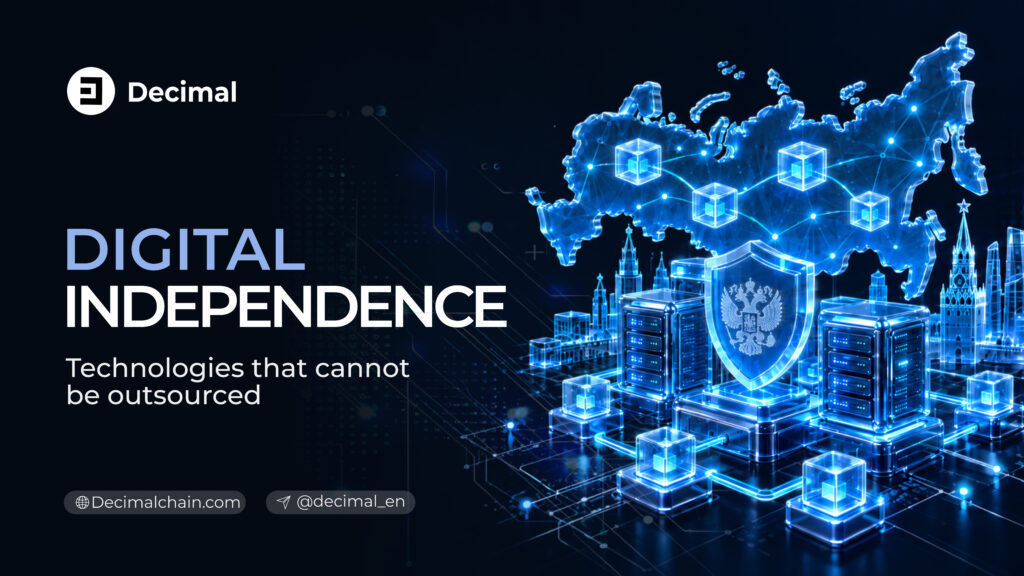
Why Russia Needs Its Own Blockchain Technologies
Having domestic blockchain technology does not necessarily mean building a closed national network. What matters more is having the expertise, infrastructure, and teams capable of deploying, maintaining, and modifying such systems independently.
For the digital economy, the same principle applies as in other areas of IT: critical technologies should be understood at the level of code, architecture, and operations, rather than simply used as ready-made products.
Technological Independence Starts with Expertise
A country can use a ready-made foreign product while remaining completely dependent on an external team. As long as the service works, this dependence may be barely noticeable.
The problem becomes apparent when an urgent update, protocol change, security audit, integration with a local system, or recovery after a failure is required.
Domestic expertise means having developers, architects, security specialists, node operators, and teams within the country who can support the technology throughout its entire lifecycle.
Control Over Infrastructure
A blockchain consists of more than code. Its infrastructure includes nodes, validators, RPC endpoints, indexers, explorers, wallets, APIs, and monitoring systems.
When an organization can deploy and maintain these components independently, it gains greater control over service availability, data storage, and the update process.
This is particularly important for large systems, where a single external service should not become the only point on which the entire infrastructure depends.
Compatibility Matters More Than Isolation
Technological independence does not mean abandoning global standards.
On the contrary, compatibility with EVM, familiar APIs, and widely used developer tools reduces integration costs. Teams can use a broad range of existing solutions while maintaining control over their own technology layer.
This approach combines two advantages: operational independence and compatibility with the global development ecosystem.
Why Local Projects Matter
Technology develops faster when products are built on top of it.
Russian developers have a better understanding of local processes, business requirements, payment systems, document workflows, support needs, and user behavior. This knowledge helps them create applications that would be difficult to design based solely on general international experience.
A local ecosystem also provides another benefit: practical experience for specialists. The more real services are launched, the more engineers gain experience applying blockchain technology to specific tasks.
What Open Architecture Provides
For domestic technology, it is particularly important to be able to inspect, deploy, and integrate components without depending on a proprietary vendor.
An open architecture makes it possible to conduct audits, build custom interfaces, deploy infrastructure, and develop additional tools around the network.
DecimalChain demonstrates one approach to this model. The network is developing as blockchain infrastructure with EVM, APIs, SDKs, validators, an explorer, and tools for creating custom tokens and applications.
The value lies in the capabilities of the local team rather than simply in where the technology originates. What matters is the ability to maintain the network, develop its tools, and build products that solve specific problems.
For Russia, domestic blockchain expertise is primarily an engineering resource. It allows the country to understand the technology, manage infrastructure, train specialists, and retain the ability to develop digital systems independently.